Installed as a public reference resource, Hate Library explores the language of far-right political groups and parties across contemporary Europe, especially their use of online forums as recruiting and collaboration tools. The inter-related components on show mix allegory and literalism by presenting texts as documentary artworks within a symbolic and social stage for reading, understanding and dialogue.
The arrangement of the installation translates the Flag of Europe, the order it was supposed to represent, and the contradictions now straining that endeavour. On blue orchestral lecterns, samples of on-going public discussions between supporters of twelve of the most significant far-right groups from European nations have been exported from their original digital platforms and rematerialised here as yellow-bound ‘History Books’. Each of these unedited volumes pauses one conversation, repeating it offline by using simple data-gathering and print-on-demand processes.
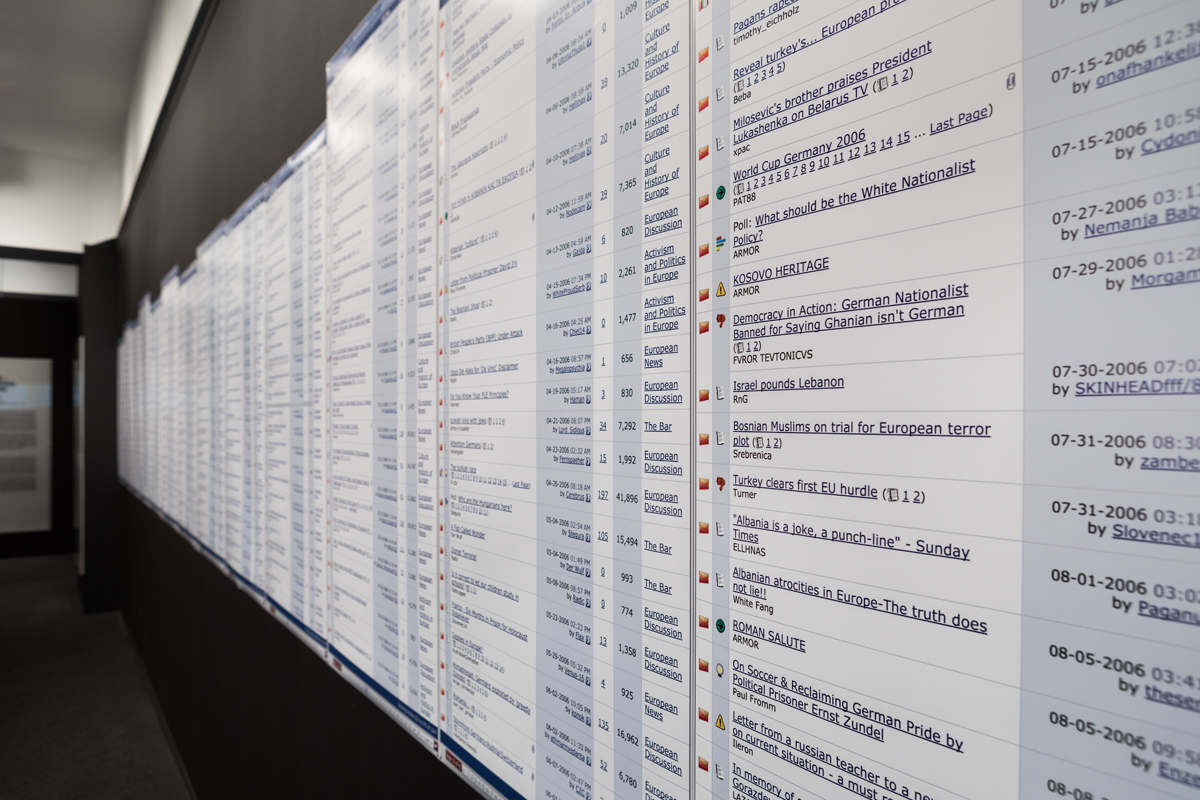
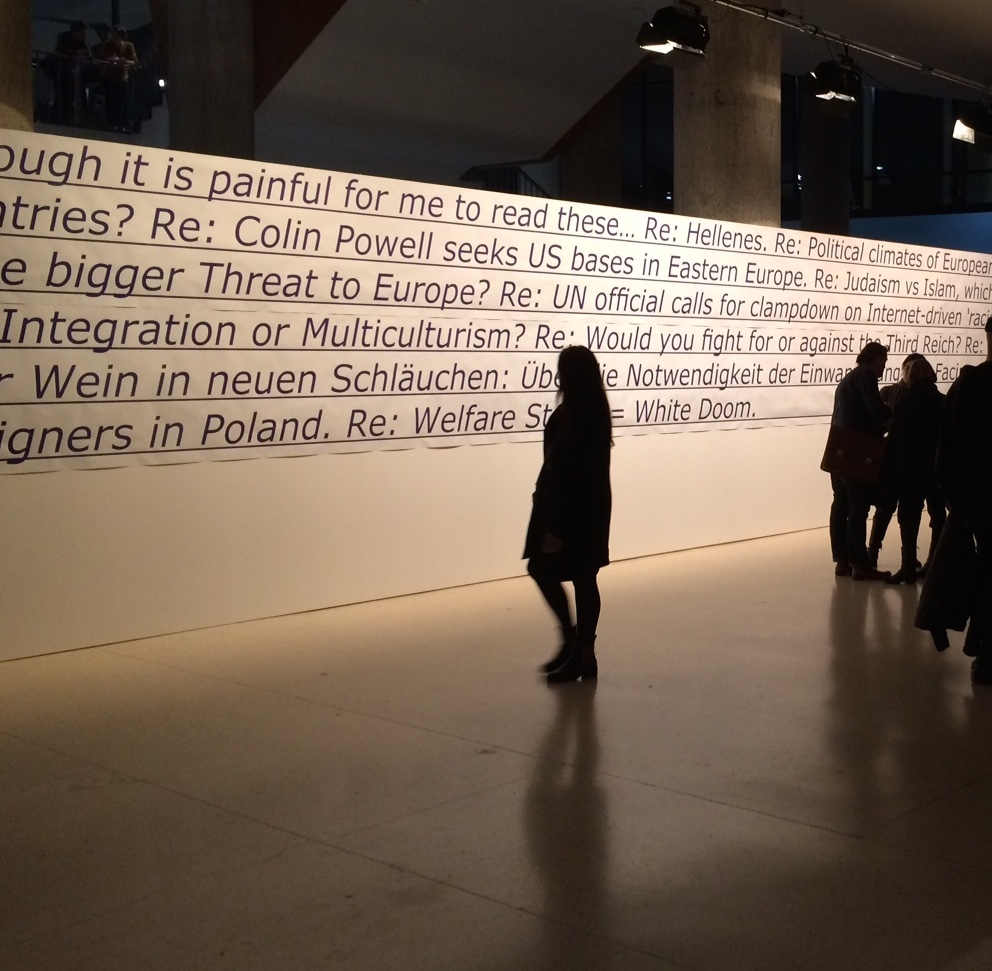
Two of the works on the surrounding walls repeat a different, lateral chain of conversation. In bands of over-sized 'hyperlink' blue text are the lines of a spiraling poem. Each phrase included is the title of a thread from a public web forum, kept in the order they were found with only duplicated titles removed, and typeset to fit the architecture of display. Encircling the lecterns is a frieze of running paper columns, which simply show the results returned by searching for the term ‘truth’ across the European sections of the Internet’s largest white supremacist discussion platform, Stormfront, ordered chronologically until three of the walls are full. Together, the threadname poem and frieze form a backdrop that signals the vexing growth of trans-national cooperation between nationalist groups, as enabled by digital networked technology. This inter-connectedness seems to be helping shrink the gap between the far-right and centres of state power in Europe and elsewhere. During the last generation, some 20 far-right parties have entered into governing coalitions around Europe.
The source material reproduced in Hate Library is offensive, mundane and just a few clicks away. It remains publicly available to Internet users anywhere in the world, and is traceable via the metadata about its collection left on show.
The sharpening problems of civic cohesion and free speech at the heart of this project are condensed in the final component, a collaged poster poem. From back to front yet big to small, an iconic photograph of Oswald Mosley addressing a fascist rally in 1930s London and a screen grab of the British National Party's Twitter feed sandwich a news media image of pro-EU liberals marching in Warsaw. The slogan-poem printed over the top remixes a pair of colloquial English wordplays and a metaphor used in dramaturgical sociology. Through its combinations of text and image, this poster highlights the differences between ‘front-stage’ and ‘back stage’ behaviour by far-right groups and parties, as well as their mobilisation of PR-friendly strategies to conceal and legitimate the beliefs that actually unify their memberships.
Hate Library documents a few of the stances adopted by far-right and rightwing fringe communities. It also juxtaposes the often confusing overlaps between public (front stage) and online activist (back stage) political discourses, and between practises of political self-imaging in a changing Europe – one that seems to be harking backwards towards new crises in frighteningly familiar language.
The project was developed in consultation with founding Director of the Centre for Analysis of the Radical Right, Matthew Feldman, and a network of activist-reserahcers around Europe. It was originally commisioned by Katarzyna Krysiak for Foksal Gallery in Warsaw, with support from the British Council, and has been adapted and re-staged numerous times since in Berlin, Vienna, and Dortmund. Copies of all 12 volumes from the History Books component are held in the Library of Artistic Print on Demand in Munich, founded by Andreas Bülhoff and Annette Gilbert.
In lieu of a catalogue, I co-edited Post-Digital Cultures of the Far Right: Online Actions and Offline Consequences in Europe and the US, a transdisciplinary collection of new essays about the topics raised by Hate Library, funded by the Antonio Amadeu and Rosa Luxembourg Foundations and published by Transcript Verlag in their Political Science series.