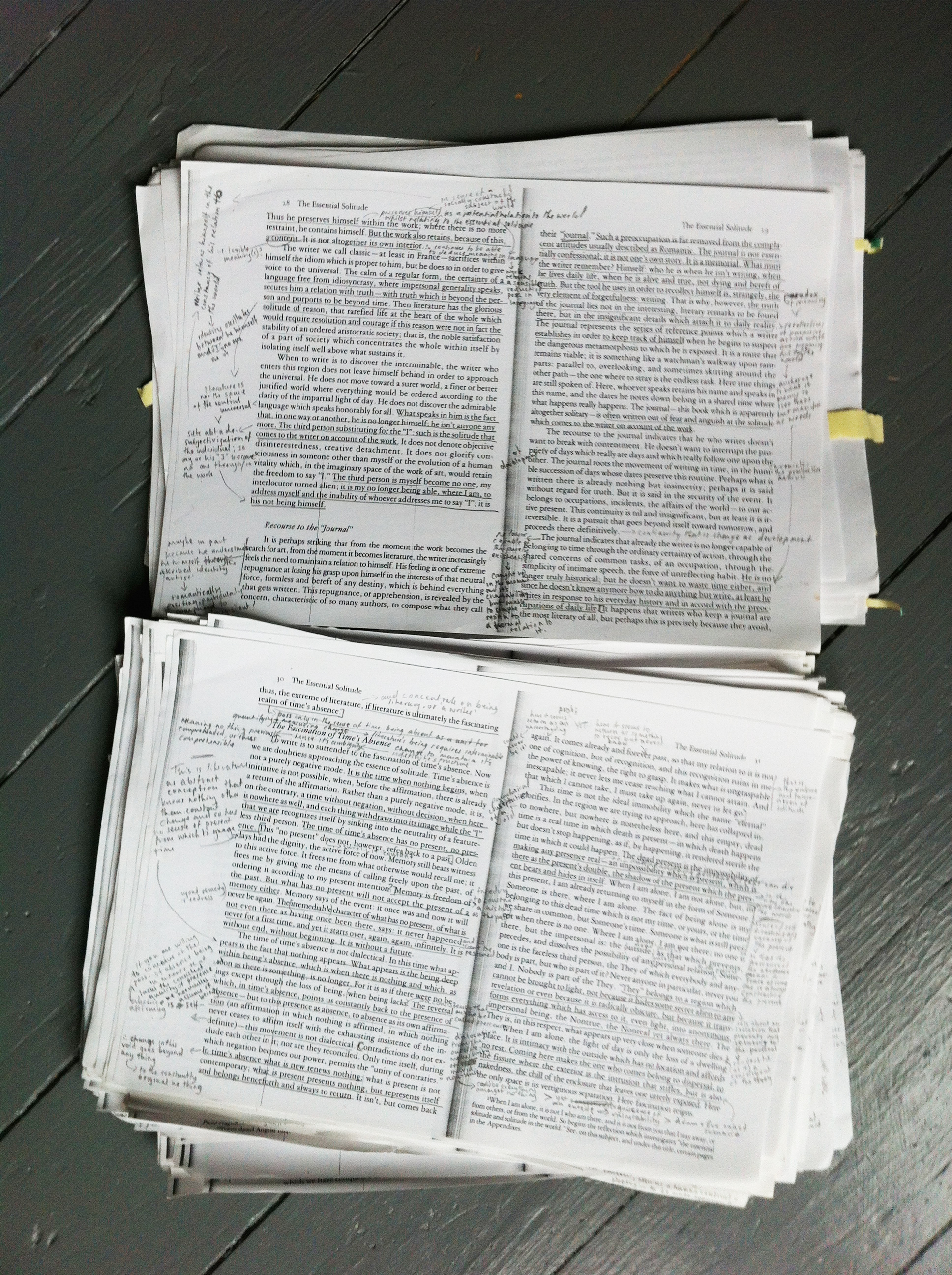
This book is a reading of the English-language translation of Maurice Blanchot’s seminal 1955 book L’Espace littéraire, performed on the page as an annotative writing that encircles the should-be space of print. Through the progressive appropriation and then erasure of Blanchot’s text, and through a processual transposition of hand-writing into formal typography, this book offers something quite unlike any other.
Following the spirit of Blanchot's essay collection, Reading the Remove of Literature is an intervention into The Book as a space of knowledge. In it, I try to render the paradoxical relationship of the artistic act and the art work – the very question of the possibility of literature that obsessed Blanchot – in the act of reading. The meaning of the reflections and meditations which form the marginalia is suspended in a tension with the suggestions of the absent text. Floating alone, these annotations may have little worth or make little sense, but between these covers they are constantly anchored by that which is missing. It is a creative erring, a process of suspended over-coming, which in this book asserts an equality of presence between the read and the written, the reading and the writing, with an energy that Blanchot fantasised about. In Reading the Remove of Literature, that destabilsing energy is contained by two tiers of framing: the page edges the text continues beyond (the crop), and the bindings that hold all the content together and hold it still (the container).
"By removing Blanchot’s text, Thurston paradoxically gives us Blanchot’s work; he presents rather than absents language. The book proffers the gift of theft. Which is as much as any work of literature, in Blanchot’s definition, can do.… Countersigning Blanchot’s text, Thurston also forges his name. Whiteness, witness: the proper genre for Reading the Remove of Literature may be portraiture."
— from the Introductory essay, ‘Cenography' by Craig Dworkin